
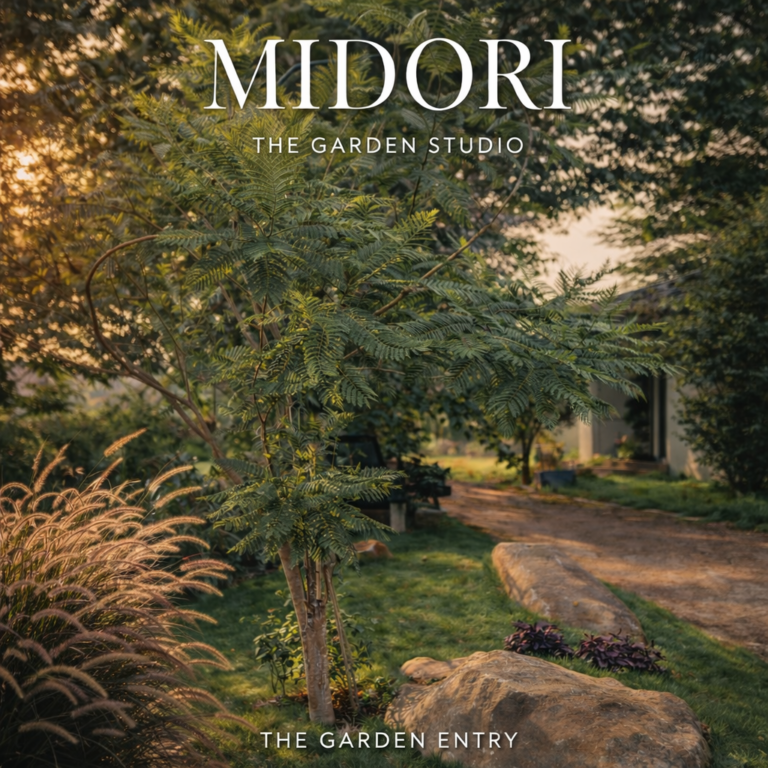
The boulders placed across the garden were all sourced from the site excavation. Rather than treating them as debris, they have been positioned deliberately — anchoring the space, adding weight, and grounding the otherwise soft landscape. They now act as quiet markers of the site’s original condition, almost like a memory embedded into the garden.
Movement was introduced through planting.
Pampas grass was placed where the breeze naturally flows along the edge of the bungalow. It brings a lightness to the composition — constantly shifting, catching light, and softening the harder elements of stone and earth. It is subtle, but it changes the way the space feels.
The trees are still young, but already defining the future of the space. Saplings of Tabebuia rosea have begun to establish themselves, and over time will form a shaded edge along the approach. Alongside them, locally sourced trees planted about a year and a half ago are now fuller, greener, and starting to create a sense of enclosure — especially around the parking zone, where shade will become an essential layer.
This is a garden that is still growing into itself.
It is not about immediate perfection, but about setting the right framework — one that allows the landscape to evolve naturally over time. The forms are simple, the palette restrained, and the materials honest to the site.
At Midori, we often believe that the most meaningful landscapes come from working with what exists, rather than against it.
This garden holds that idea quietly — shaped not by addition, but by thoughtful transformation.
— Beena Sambaragimath
Founder & Curator, Midori – The Garden Studio