
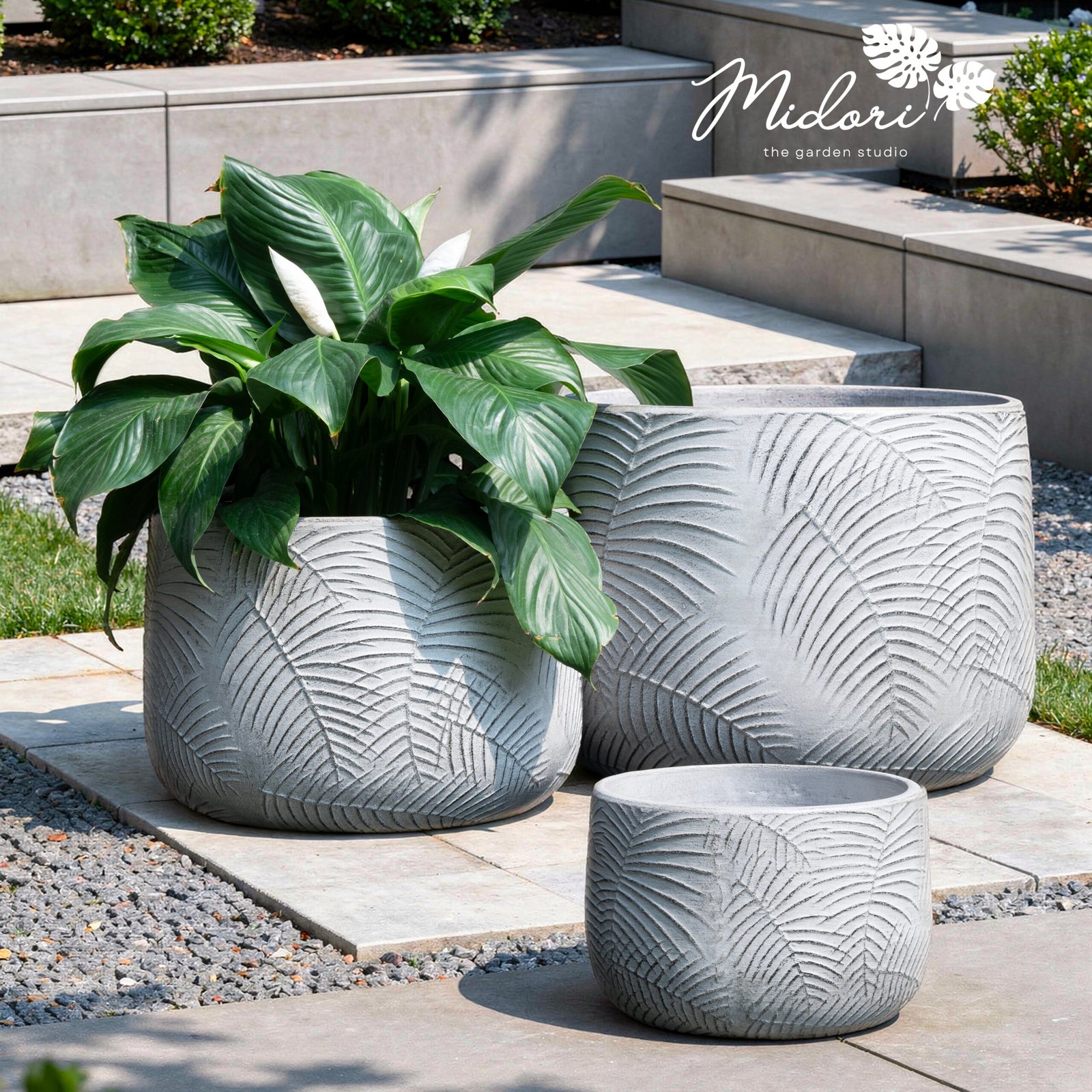
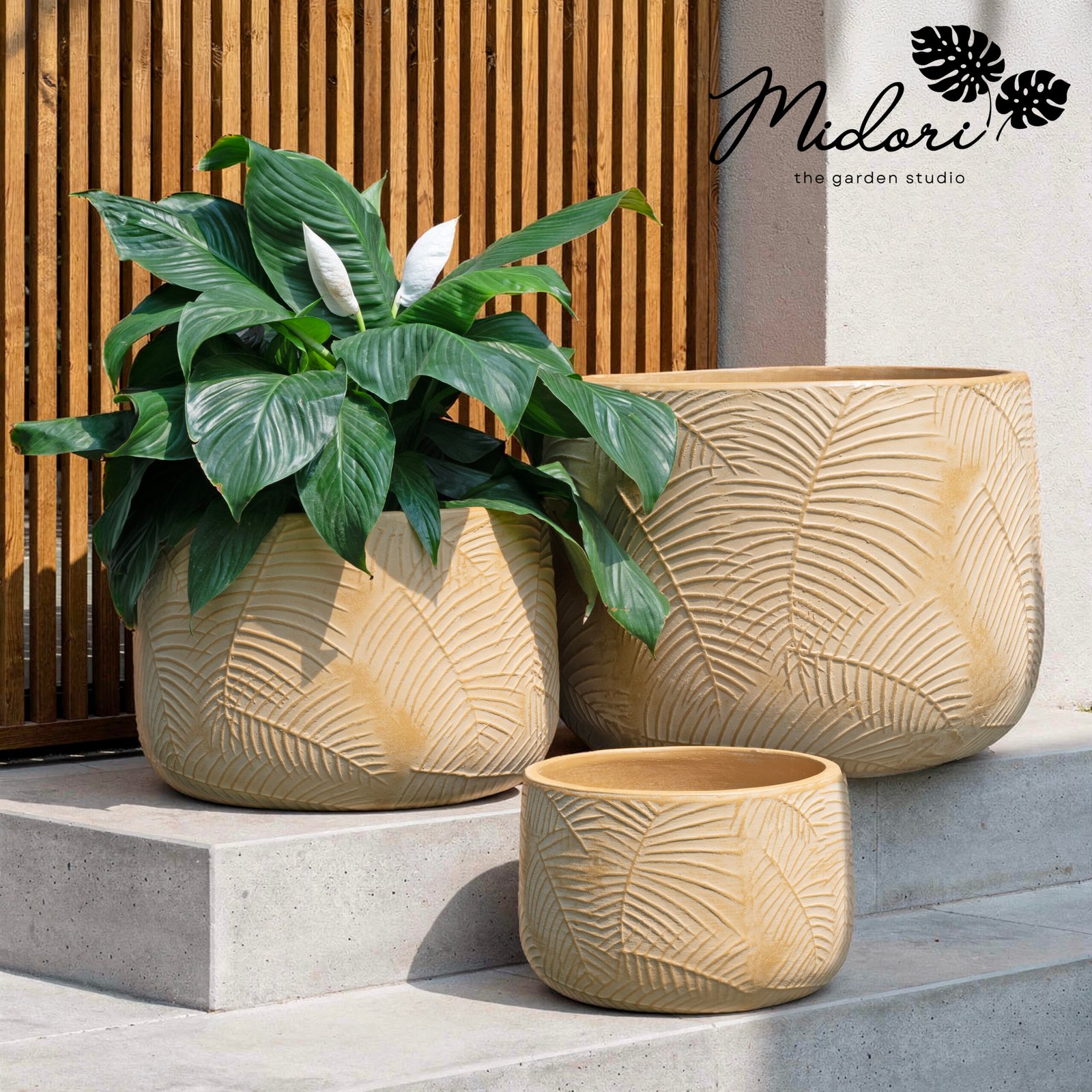
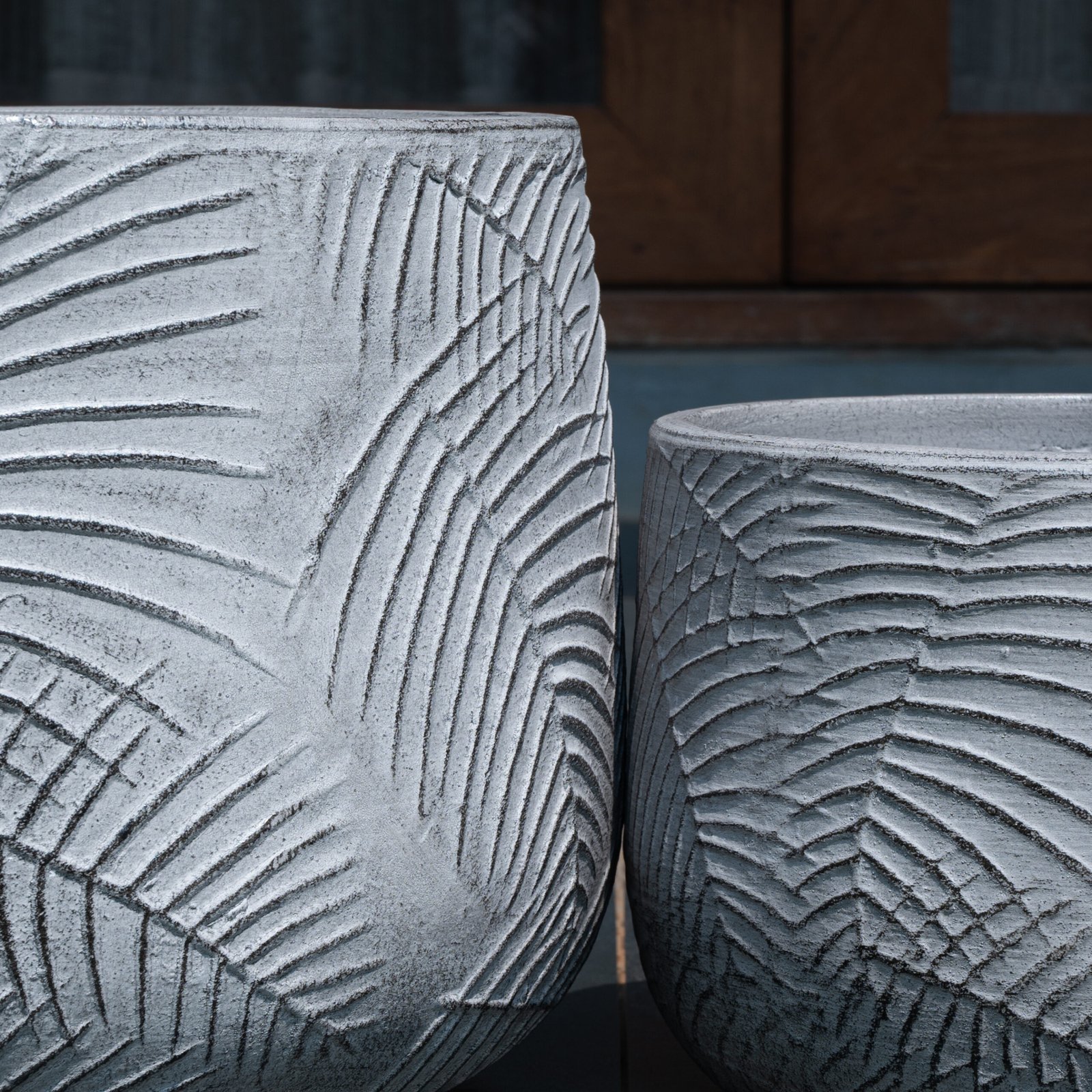
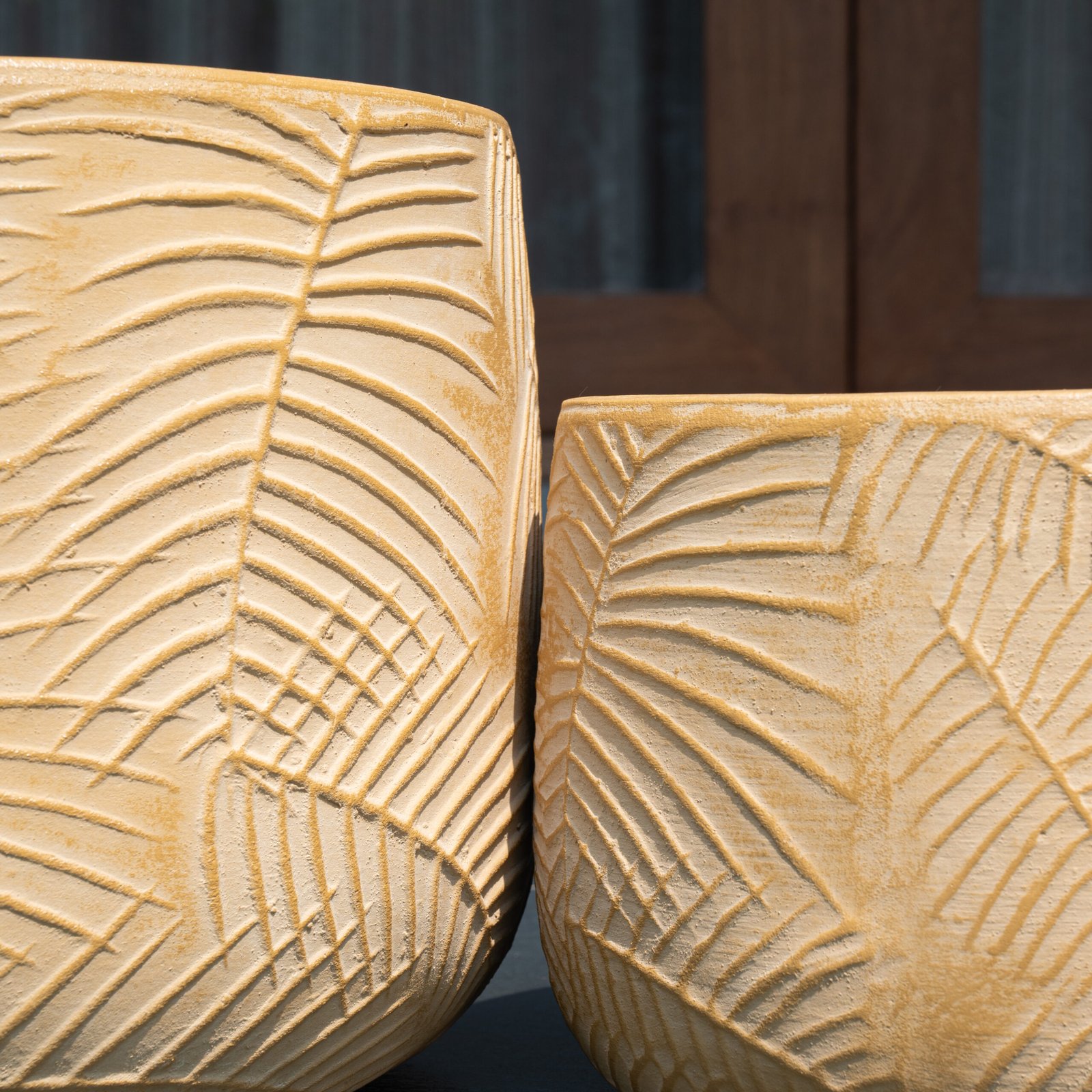
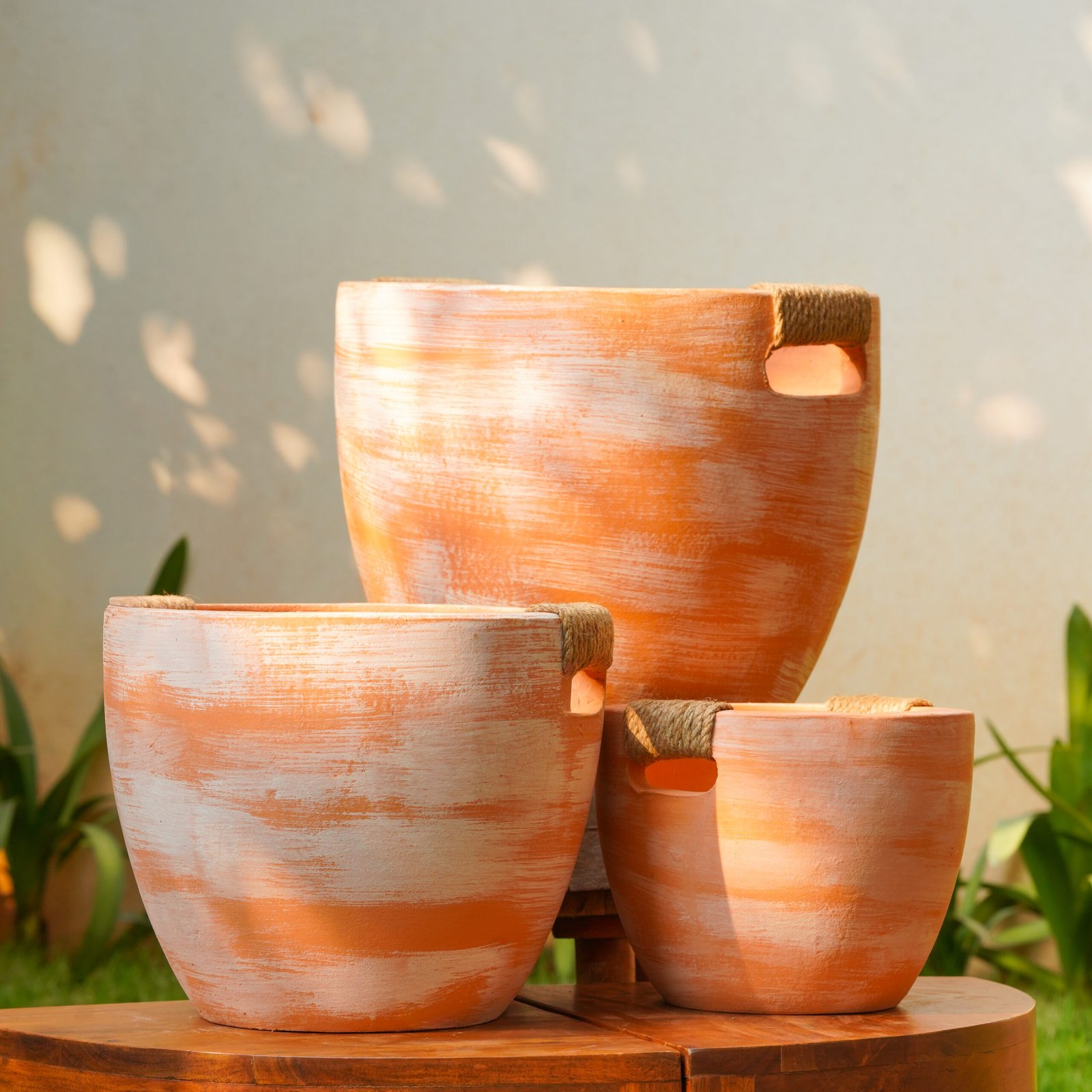
Areca is named for the palm — and the palm is everywhere on it. Sweeping frond impressions overlap and layer across the wide bowl form, each line pressed into the terracotta before paint was applied by hand. The result is a surface that is never quite uniform: the paint catches on the raised ridges and thins in the recessed lines, shifting tone with every change in light.
Two finishes, two moods. Sand is warm sandy-amber — earthy, sun-bleached, glowing gold at golden hour as the frond ridges catch the light. Concrete is cool weathered grey — rough and granular like stone that has been outside for a decade, the palm relief sharper and more graphic in the cooler tone. Both are hand-painted matte finishes on the same form, with the same palm frond story — the choice between them is the choice between warmth and restraint.
The wide, low bowl — significantly broader than it is tall — is designed for plants that spread rather than climb. At 54cm across, the Large anchors a living room corner, a covered patio, or an entrance with genuine authority. The Small carries the same surface drama in a form compact enough for a step or a shelf.
Each Areca is hand-painted. Slight variation in tone, texture, and finish depth is inherent to this process — it is the mark of an individual piece, not a defect.
Part of our Botanica Collection · Hand-Painted Matte Terracotta · Indoor / Covered Outdoor
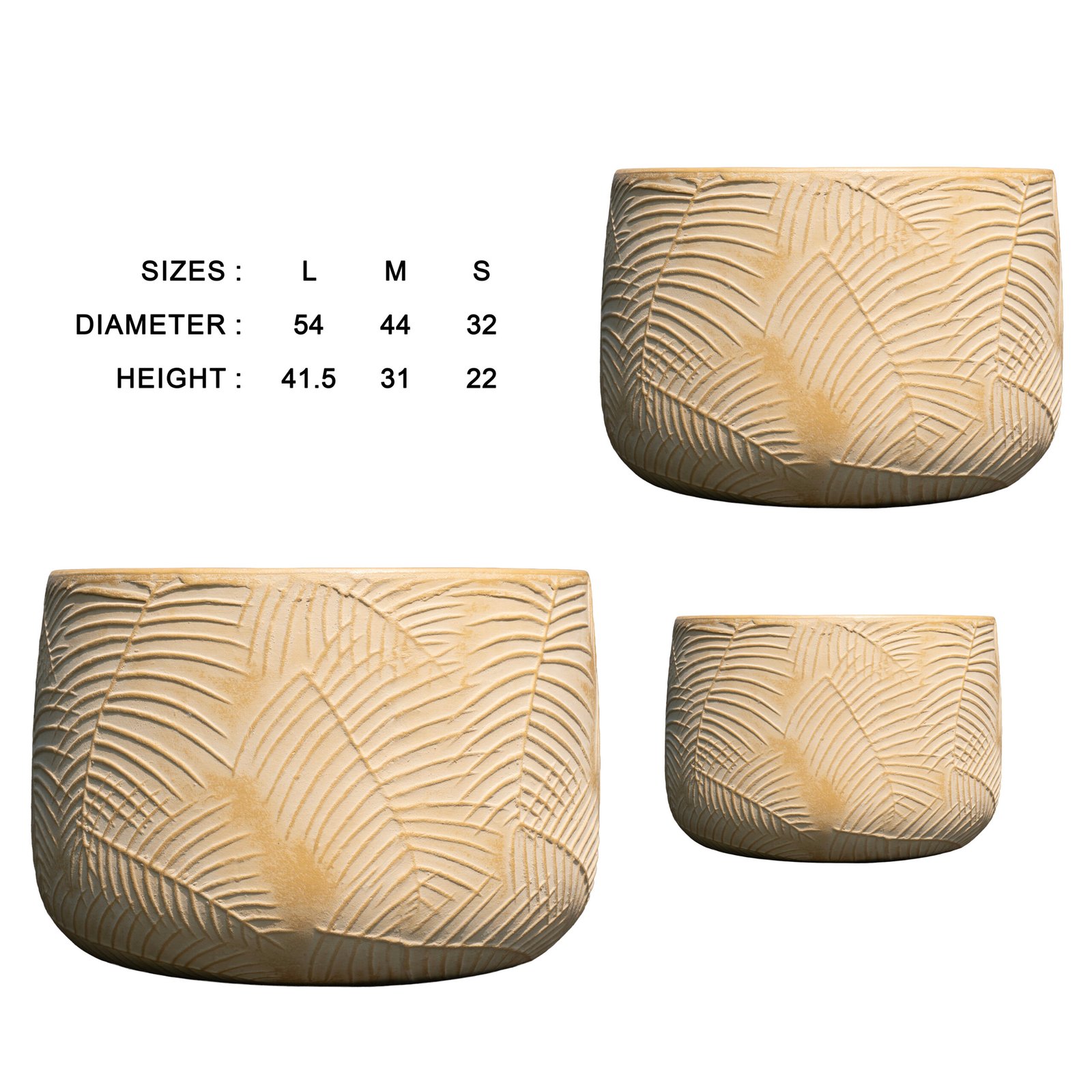
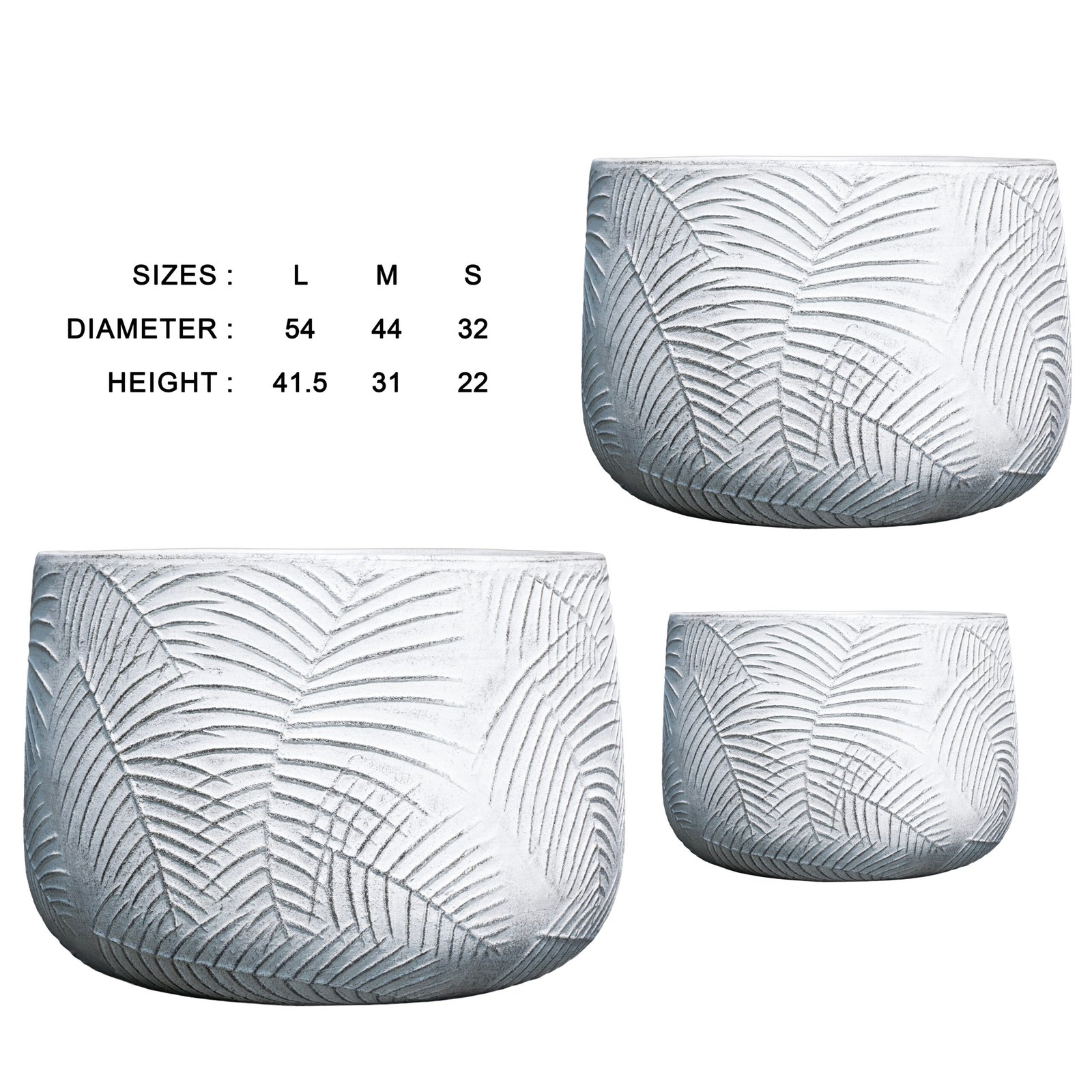
Large: 54cm dia × 41.5cm H · Medium: 44cm dia × 31cm H · Small: 32cm dia × 22cm H
Care & Placement
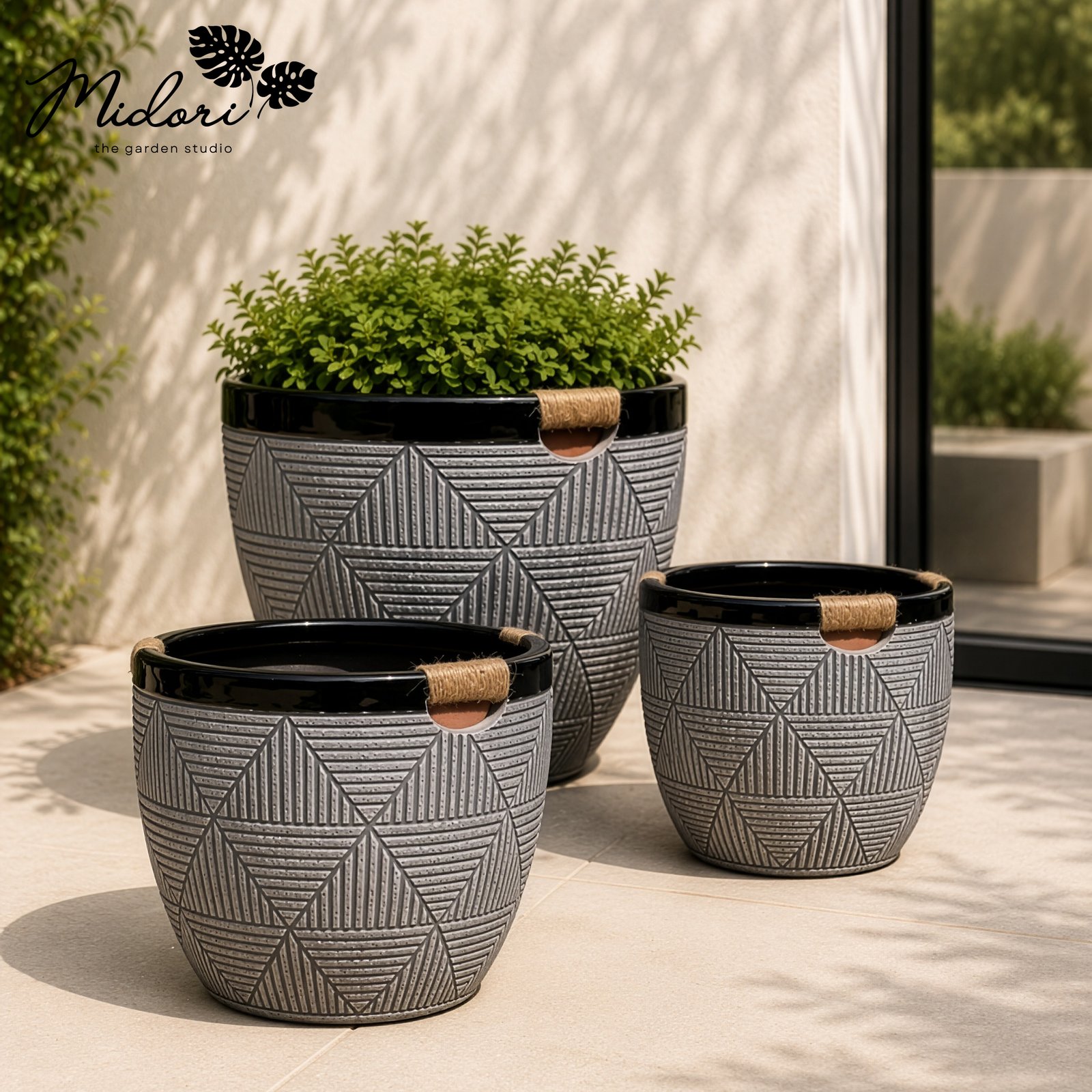
Indoor and covered outdoor only (although for illustration the photograph is shot outdoors). The hand-painted matte finish is not sealed — avoid direct rain and prolonged harsh sunlight. Clean with a dry or barely damp cloth only; do not scrub or use water freely on the surface. Single base drainage hole. Use a saucer indoors. For succulents, add a gravel layer at the base or drop in a nursery pot. For moisture-loving plants, plant directly with well-draining potting mix.
Best Paired With
| Mood | Plants | Light & Water | Sand | Concrete |
|---|---|---|---|---|
| Tropical & Expansive | Areca Palm, Bird of Paradise, Monstera Deliciosa | Bright indirect · every 5–7 days | ✓ Large only | ✓ Large only |
| Warm & Lush | Peace Lily, Golden Pothos, Philodendron | Medium indirect · every 5–7 days | ✓ All sizes | ✓ All sizes |
| Sculptural & Considered | Sansevieria, ZZ Plant, Aglaonema (silver) | Low–medium · every 10–14 days | △ Medium & Small | ✓ All sizes |
Find Your Pairing
| Plant | Sand | Concrete | Note |
|---|---|---|---|
| Areca Palm | ✓ Perfect | ✓ Perfect | Large only · fronds above echo fronds below |
| Peace Lily | ✓ Perfect | ✓ Perfect | White blooms on warm or cool ground · use saucer |
| Monstera Deliciosa | ✓ Perfect | ✓ Perfect | Large & Medium · bold tropical foliage suits the wide form |
| Golden Pothos | ✓ Perfect | ✓ Strong | Gold-green trails complement Sand’s warmth naturally |
| Sansevieria ‘Moonshine’ | ✓ Strong | ✓ Perfect | Silver-pale form reads beautifully against Concrete’s cool grey |
| White Anthurium | ✓ Strong | ✓ Perfect | Formal contrast · medium size · gallery-ready against Concrete |
| ZZ Plant | ✓ Strong | ✓ Strong | Low-light · glossy dark leaf pops against matte surface in both |
| Philodendron | ✓ Strong | ✓ Strong | All sizes · lush and forgiving · trails over the wide rim |
| Bird of Paradise | △ Possible | △ Possible | Large only · needs consistent bright indirect light indoors |
| Caladium | △ Possible | △ Possible | Medium · striking · needs humidity · keep away from AC vents |
| Cactus or single small succulent | ✗ No | ✗ No | Scale mismatch · this form demands generous, full planting |
Beena’s Curating Tips
The Areca Palm in the Areca planter is not coincidence — it is the composition Beena returns to first. The embossed fronds on the vessel and the living fronds above create a conversation between form and foliage that looks inevitable, not arranged. Works in both shades; particularly striking in Sand where the warm tones align.
Choose your shade by the room, not the plant. Sand belongs in spaces with warm materials — raw wood, jute, cane, terracotta tiles, linen. Concrete belongs in spaces with cool ones — polished stone, concrete floors, white walls, dark metal. The plant palette for both is almost identical; the room is what changes.
The surface texture is the story up close. Run your hand across it and you feel every frond ridge. Position Areca where people will walk past and look down — the hand-painted relief catches that attention better than any smooth glaze could.
The wide bowl form is designed for plants that spread outward, not upward. Peace Lily, Pothos, and Philodendron do this naturally — they relax over the rim and let the form breathe beneath them. Avoid tall, upright plants in the Medium and Small; the proportions work against them.
For B2B: Concrete is the shade architects and interior designers reach for — it recedes into the brief and lets the plant lead. Sand is the shade hospitality clients choose — it brings warmth to a lobby or verandah without demanding attention. Pitch them as a pair for large commercial installations: one Sand, one Concrete, same form, same scale, side by side. Each Areca is hand-painted — no two are identical. The variation in tone and finish depth is not inconsistency; it is the evidence of the hand; it becomes a reason to buy, not a reason to hesitate.
Reviews
There are no reviews yet.