
On the quiet genius of a ceramic fountain as garden anchor — and how the sound of moving water beneath a mango tree can give an entire landscape its reason for being.
There is a particular kind of garden that stops you mid-step. Not because it is trying hard. But because it isn’t. The garden in this photograph is one of those places — composed with a quiet authority that only comes from a designer who has learned to listen to a space before imposing anything upon it. This is a client garden in Belagavi, curated entirely by Beena Sambargimath, founder of Midori — The Garden Studio.
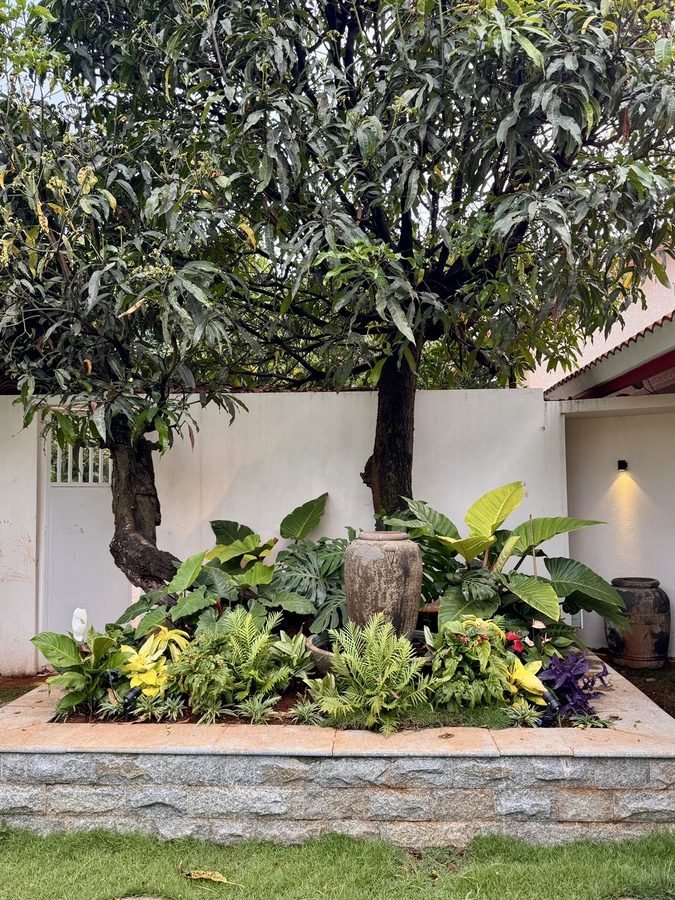
Beena’s starting point, as it always is, was the existing soul of the site: a mature mango tree, twin-trunked and generous, its canopy already forming a natural ceiling over the raised garden bed below. Everything she chose — the fountain, the foliage, the layers of colour — was placed in conversation with that tree, not in competition with it. The result is a garden that feels discovered rather than designed. And at its centre: a large ceramic fountain, broad-shouldered and stone-finished, from which everything else takes its cue. When the water moves, it gives the garden a pulse.
"Water in a garden does not just move — it listens. It catches light, holds shadow, and makes every surrounding leaf a little more alive."
Reading the Garden
Step back and read this composition the way you would a painting. The mango tree is the vertical drama — its gnarled twin trunks rising from the same root like a family portrait, its canopy a loose, breathing ceiling of green. Against the clean white perimeter wall, it becomes something architectural. A living column. Beena chose to work with it, not around it — letting the tree define the mood and allowing every other decision to follow from that.
The garden bed has been raised on a granite-edged plinth — at once practical and deeply considered. It lifts the planting off ground level, removes it from the ordinary, and frames the composition like an installation. What sits here is meant to be experienced, not merely glanced at.
And at the centre of it all — water. Beena placed the ceramic fountain not as a decorative afterthought but as the organising principle of the entire bed. The ear arrives before the eye does: that quiet sound of water trickling over a ceramic lip is the first thing you register as you approach. The eye then follows — drawn to the fountain, released outward into the foliage, pulled back again. It is the mark of a well-composed landscape: it engages more than one sense, and it holds your attention without demanding it.
The Plants: Beena’s Palette Around Water
The planting palette in this garden is entirely Beena’s — each variety selected not just for its individual beauty but for how it behaves in this specific microclimate: deep mango shade above, a working fountain at the centre, and the ambient humidity that moving water creates around it. This is layering with intention, where colour, texture, and light response were all considered together:
- Calathea — Beena’s deliberate colour statement and perhaps the most considered choice in the entire bed. Varieties such as Calathea ornata (dark leaves with pink pinstripes), Calathea medallion (burgundy undersides, deep green patterns), and Calathea roseopicta bring extraordinary pattern and colour to the mid-layer. Calathea thrives in exactly the conditions this garden offers — consistent indirect light under a dense canopy, and the localised humidity generated by the fountain. What would struggle in open sun becomes glorious here.
- Philodendron gloriosum / Philodendron mamei (Wavy Leaf Philodendron) — Beena’s choice of a wavy-leaf Philodendron rather than the more commonplace Monstera is the detail that signals a truly curated hand. The large, heart-shaped leaves with their gently undulating margins and silver-veined surfaces are at once exotic and deeply lush — a plant that garden designers know and plant lovers covet. Under the dappled shade of the mango canopy, this Philodendron unfurls with an almost theatrical slowness. Architectural foliage that feels genuinely rare.
- Colocasia (Taro / Elephant Ear) — Wide, heart-shaped leaves in lime-green that create a luminous contrast against the dark mango bark. They catch light like sails and lean naturally toward the moisture the fountain provides.
- Ferns (Nephrolepis / Boston variety) — The delicate, feathery groundcover that softens every edge. Ferns fill the bed with movement at the slightest breeze and positively flourish in the humidity of a working water feature.
- Croton (Codiaeum variegatum) — A burst of yellow-and-green variegated foliage at the right foreground — the joyful note, the warmth that stops the palette from becoming too cool and contemplative.
- Purple Alternanthera / Persian Shield — The deep violet-purple accent at the lower right. Every well-composed garden needs a shadow tone to make the brighter colours sing. This delivers it perfectly.
- Anthurium / Peace Lily — The white spathe on the far left — a single sculptural flower that punctuates all that green with stillness and calm.
- Ixora / Low ornamental flowering shrub — The red-pink cluster in the right mid-ground. A flash of warmth that draws the eye and then releases it back into the green.
What makes this palette remarkable is its internal logic. Beena has built a gradient of colour — from the deep purples and patterned Calatheas at the lower layers, through the many greens of the mid-height foliage, into the luminous yellow-greens of the Colocasia at the top. Warm accents of red and white punctuate without disrupting. The fountain sits at the centre of all of it — the point from which all this colour radiates outward, and to which the eye always returns.
Six Principles at Work Here
Water as Anchor
A ceramic fountain placed at the visual centre of a bed does what no static object can — it creates perpetual movement. Everything else in the composition stills around it, which paradoxically makes the whole garden feel more alive.
Raised Plinth
Elevating a garden bed changes its relationship with the viewer. It signals intention. A plinth says: this is not an afterthought. It is a composition worth pausing for.
Layered Heights
Ground, mid, and tall. Three distinct levels of planting create visual depth. The eye travels through the garden rather than simply arriving at it.
The Wall as Canvas
A clean white perimeter wall is among the most underused design assets in an Indian garden. Against it, every dark trunk and bright leaf becomes a brushstroke — and the sound of water bounces back gently, wrapping the space in its
Light After Dark
The wall-mounted spotlight visible on the right transforms this garden at dusk. Uplighting a fountain creates a second magic — water carries light in ways that stone and soil never can. The ripple becomes luminous.
The Second Vessel
There is a second ceramic piece in the deep right background — partially obscured, deliberately so. This restraint, showing just enough, is what separates a designed garden from a decorated one.
On the Fountain — and Why Ceramic
The ceramic fountain Beena chose for this garden is substantial — tall, wide-mouthed, with a surface finished to evoke aged stone, mottled in grey and earthy brown. The choice of ceramic over terracotta was deliberate. Ceramic is fired at significantly higher temperatures and carries either a glaze or a sealed finish that makes it suited to continuous outdoor use: rain, monsoon humidity, the constant presence of recirculating water, and years of Belagavi seasons. Where terracotta would eventually show wear, ceramic grows into itself — the mottled grey finish will only deepen and improve with time.
Beena positioned the fountain without a plant. Water alone is its occupant, and water is enough. A recirculating pump moves quietly beneath the surface — the sound that reaches you is barely a whisper. More a presence than a noise. It is the kind of sound your nervous system recognises before your mind does. It says: slow down. You are in a garden now.
At Midori, our ceramic outdoor range is conceived for exactly this kind of placement — pieces that function as both vessel and sculpture, that earn their place in a landscape and hold it for decades. Beena selects each piece with the same eye she applies to every other design decision: what does this space need, and what form will serve it best?
"The mango tree was chosen, nurtured, given time. The fountain was placed beneath it with the same considered care. Design is not about what you add — it is about what you commit to."
How to Bring This Home
You do not need a century-old mango tree or a quarter-acre plot. The principles of this composition scale beautifully to a terrace garden in Bengaluru, a verandah in Pune, a walled courtyard in Hyderabad. What you need is:
A strong vertical backdrop — a mature tree, a high compound wall, or a large architectural planter behind the feature. A raised or defined bed — even a gravel border or granite edge will lift the composition. A ceramic fountain as your anchor — one substantial, well-chosen piece at the centre. Size matters here: go larger than feels comfortable indoors and it will feel exactly right outside. Three layers of planting — ground cover, mid-height foliage, and one or two bold large-leafed plants flanking the fountain. A recirculating pump — discreet, low-wattage, sufficient to keep water audible without creating unnecessary noise. And finally, one light source — a wall-mounted spotlight angled toward the fountain for evenings when the water carries the light.
That is the entire recipe. The rest is patience, and the particular way the water sounds on the afternoon you first switch it on.
A Midori Garden in Belagavi
Belagavi sits at an elevation of roughly 760 metres, with a climate that is generous to tropical planting and outdoor ceramics alike. The air holds enough humidity that a working garden fountain never feels like an indulgence — it feels like a natural extension of the landscape. The light here is golden for much of the year. And there is a long tradition of nurturing courtyard and compound gardens in this city, with a quiet seriousness that the rest of India is only now beginning to rediscover.
Beena founded Midori from within this tradition. Her belief — which runs through every studio project and every piece in the Midori range — is that a garden is not an addition to a home. It is the home’s first impression, its emotional exhale, the place where the day begins and ends with some measure of grace. When she designs a garden for a client, she is not simply selecting plants and placing objects. She is composing an experience that the client will live inside, every morning, every evening, through every season.
This Belagavi garden is a clear expression of that philosophy. Alive with colour and pattern — the Calatheas alone making it unlike any other garden on the street. Layered with texture and shadow. Anchored by water. And held together, in the way that only a considered hand can manage, so that it feels not designed at all. Just inevitable.